
What does an option Greeks calculator show?
An option Greeks calculator estimates how an option's theoretical value may respond to one changing input at a time. Delta focuses on the underlying price, Gamma on the change in Delta, Theta on time passing, Vega on implied volatility, and Rho on interest rates. The five numbers describe sensitivity; they do not predict the next quote.
Most calculators use a Black-Scholes or Black-Scholes-Merton framework. You provide the underlying price, strike, time to expiration, implied volatility, risk-free rate, dividend yield, and whether the contract is a call or put. The model returns a theoretical option value plus the Greeks in their own units.
Use the output as a controlled scenario tool. Compare the signs and magnitudes with the option chain, check the model assumptions, and remember that early exercise, dividends, liquidity, bid-ask spread, and volatility changes can make a live premium differ from the estimate.
The five primary Greeks and their units
The word Greek is a compact label for a partial sensitivity. A calculator changes one model input while holding the others constant, then reports the approximate change in option value. This is useful for asking precise questions: how much might a one-dollar move matter, how quickly is time value eroding, or how exposed is the premium to a change in implied volatility?
| Greek | Main sensitivity | Typical reading |
|---|---|---|
| Delta | Option value for a $1 underlying move | A call is usually positive; a put is usually negative. |
| Gamma | Change in Delta for a $1 underlying move | Usually positive for long calls and puts; largest near the strike. |
| Theta | Option value lost or gained as time passes | Long options are often negative; short options often collect time decay. |
| Vega | Option value for a 1 percentage-point IV move | Long options are usually positive; the exposure is strongest with time left. |
| Rho | Option value for a 1 percentage-point rate move | Usually more visible in longer-dated contracts and rate-sensitive positions. |
What an option Greeks calculator needs
A useful result begins with inputs that match the contract. Underlying price and strike use the same currency. Time to expiration is converted into a year fraction. Implied volatility is entered as an annualized percentage, while rates and dividend yield are annualized assumptions. If a field is copied from a broker, note whether it is mid, bid, ask, or a mark.
- Underlying price: the current or scenario price of the asset.
- Strike price: the exercise price used by the option contract.
- Time to expiration: the remaining time, expressed consistently with the model.
- Implied volatility: the annualized volatility implied by a market premium or surface.
- Risk-free rate and dividend yield: assumptions that matter more for some maturities and underlyings.
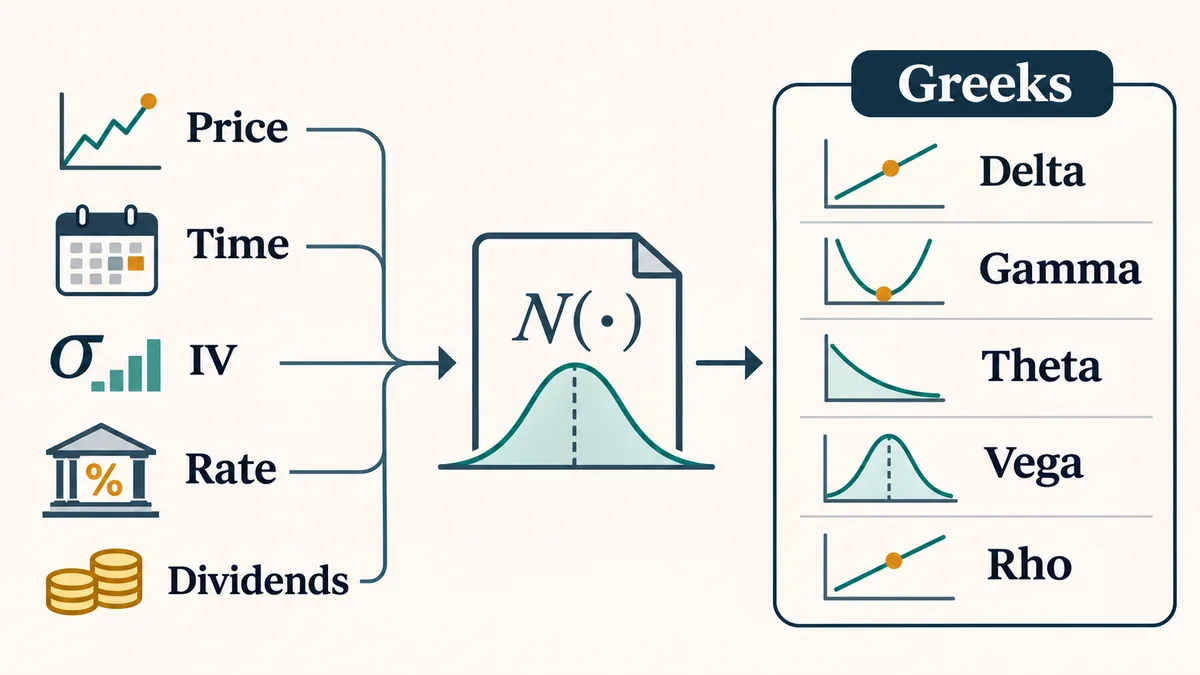
How the Black-Scholes inputs become Greeks
For a European-style option, the model first builds two standardized values, d1 and d2, from the underlying price, strike, time, volatility, rate, and dividend yield. The normal distribution then converts those values into a theoretical call or put price. The Greeks are partial derivatives of that price with respect to selected inputs.
The formula is valuable because it exposes the assumptions behind a result. It is not a promise that the market will trade at the theoretical value. American exercise, discrete dividends, volatility smiles, changing rates, and transaction costs require additional treatment or a different model.
d1 = [ln(S / K) + (r - q + sigma^2 / 2)T] / (sigma * sqrt(T)); d2 = d1 - sigma * sqrt(T)- Delta is the first price derivative and is often used as a directional proxy, not as a guaranteed probability.
- Gamma is the second price derivative, so it explains why Delta changes as the underlying moves.
- Theta is a time derivative; its display convention can be negative for long options and can change as expiration approaches.
- Vega is commonly quoted for a one percentage-point change in implied volatility, not a one-point decimal change.
Read a long call Greek snapshot
Suppose a call has an underlying price of $100, a $105 strike, 45 days to expiration, 25% implied volatility, a 5% annual rate, and no dividend yield. These values are an illustration, not a live quote. A calculator can use them to estimate the option value and the five primary Greeks at that instant.
| Input or output | Illustration | How to read it |
|---|---|---|
| Underlying / strike | $100 / $105 | The call starts out of the money by $5. |
| Time / IV | 45 days / 25% | Both time and volatility support time value. |
| Delta | About +0.42 | Small-move directional sensitivity for the long call. |
| Gamma | Positive | Delta can rise as the call moves toward or through the strike. |
| Theta | Usually negative | Time value tends to decline for a long call, all else equal. |
| Vega | Usually positive | A higher IV can lift the theoretical value of a long call. |
| Rho | Usually positive | A higher rate can raise a call's theoretical value under the model. |
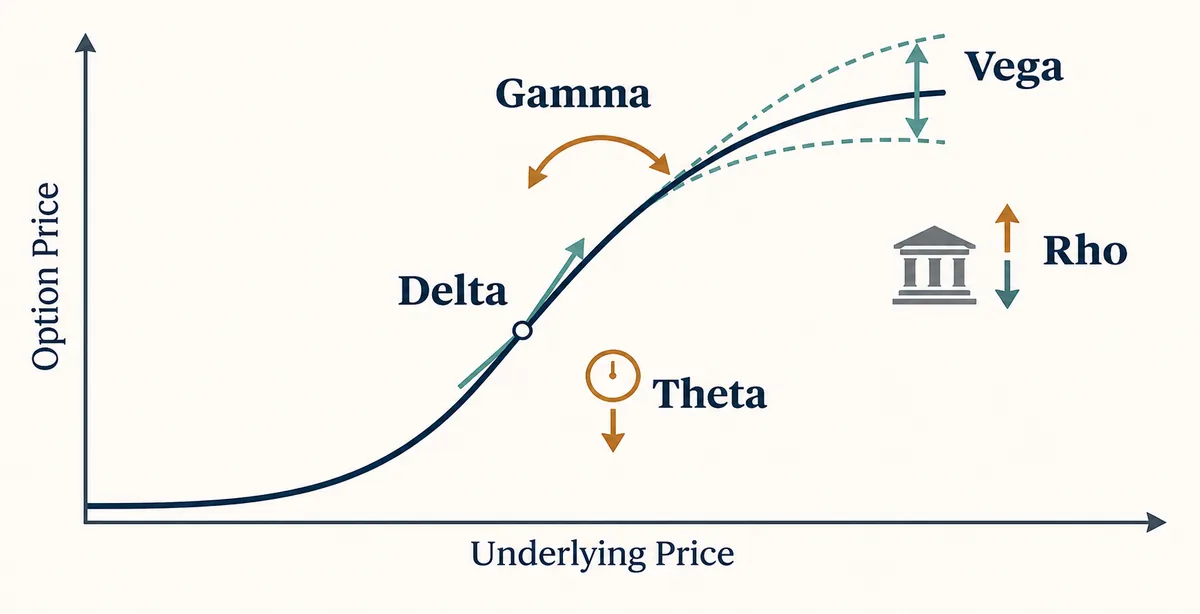
Use signs, size, and scenarios together
Start with the position direction. A short call has the opposite Delta, Gamma, Theta, Vega, and Rho exposure of the corresponding long call, before portfolio offsets. Then ask whether the number is large relative to the position size and the time horizon. A small per-share value can become meaningful when multiplied by a large contract count.
| Question | Useful check |
|---|---|
| What if the stock moves $1? | Use Delta for a small move and Gamma to understand the changing slope. |
| What if IV rises 1%? | Read Vega using the calculator's stated percentage-point convention. |
| What if one day passes? | Read Theta with its daily or weekly display convention. |
| What if rates change? | Read Rho, then consider maturity, dividends, and the contract style. |
| Does the trade still fit? | Combine the Greek snapshot with loss limits, liquidity, fees, and assignment risk. |
Common mistakes and model limits
The most common mistake is mixing units. Entering 25 instead of 0.25, using days where years are expected, or reading a per-share Greek as a per-contract result can create a plausible-looking but wrong answer. Keep a short input note beside the result so you can audit the calculation later.
Another mistake is treating Delta as a fixed probability or using a Greek far outside the neighborhood where it was calculated. Greeks are local derivatives. They change as the underlying, time, volatility, and rates change, and they can jump around a discontinuous event such as an earnings release.
- Check percent formatting: 25% volatility is not the same input as 25.0 in every interface.
- Confirm whether Theta is per calendar day, trading day, or week.
- Check the multiplier and whether the displayed Greek is per share or per contract.
- Recalculate after a large price move or volatility change; do not extrapolate a local derivative indefinitely.
How to use an option Greeks calculator
A repeatable workflow makes the output easier to challenge. The goal is not to collect the biggest list of Greeks; it is to connect each number to a decision question and keep the model boundary visible.
- Select call or put, then mark the position as long or short so the sign is interpreted correctly.
- Enter underlying price, strike, time to expiration, implied volatility, rate, and dividend yield with explicit units.
- Record the theoretical value and the five primary Greeks, including whether they are per share, contract, day, or one percent IV move.
- Change one input at a time to create a small scenario table for price, time, and volatility.
Option Greeks calculator checklist
Save the inputs with the result. A Greek without its timestamp, volatility source, and unit convention is hard to reproduce.
Review the position as a whole. Multi-leg strategies can have useful offsets, but they can also hide concentration in Gamma, Vega, or assignment exposure.
- Underlying and strike use the same currency and contract.
- Time is entered in the unit expected by the model.
- Volatility, rates, and dividends use the documented percentage convention.
- Long or short direction and contract quantity are applied after the contract Greek is read.
- The multiplier and per-share versus per-contract display are confirmed.
- The model type, exercise style, and quote timestamp are recorded.
- Fees, spreads, taxes, margin, and assignment are reviewed separately.
Option Greeks calculator FAQ
What is an option Greeks calculator?
It is a model-based calculator that estimates an option's theoretical value and its sensitivity to price, time, implied volatility, interest rates, and sometimes dividends. The output is conditional on the inputs and model assumptions.
Which Greeks matter most?
Delta, Gamma, Theta, Vega, and Rho are the primary set. The most important one depends on the position and holding period: Delta and Gamma for price movement, Theta for time decay, Vega for volatility exposure, and Rho for rate-sensitive maturity.
Is Delta the probability an option finishes in the money?
No. Delta is a local price sensitivity. Some traders use a delta value as a rough probability shorthand under specific assumptions, but it is not a guaranteed probability and should not replace a defined probability model.
Why can two Greeks calculators disagree?
They may use different volatility, rate, dividend, time-count, exercise-style, quote, or rounding conventions. Compare every input and unit before concluding that the calculation is wrong.
What does negative Theta mean?
For a long option, negative Theta usually means the modeled option value declines as time passes while other inputs stay constant. The amount changes with moneyness, volatility, time remaining, and the calculator's day convention.
Sources for the definitions and risk boundary
The explanations below are educational summaries. Consult the original disclosures and your broker's contract specifications for a trading decision.
- Options Industry Council: Volatility & the Greeks — Definitions and examples for Delta, Gamma, Theta, Vega, and Rho.
- The Options Clearing Corporation: Options Disclosure Document — Official risk disclosure and contract considerations for US listed options.